
Fashion Designing Course After 12th: Best Skills for Future Designers
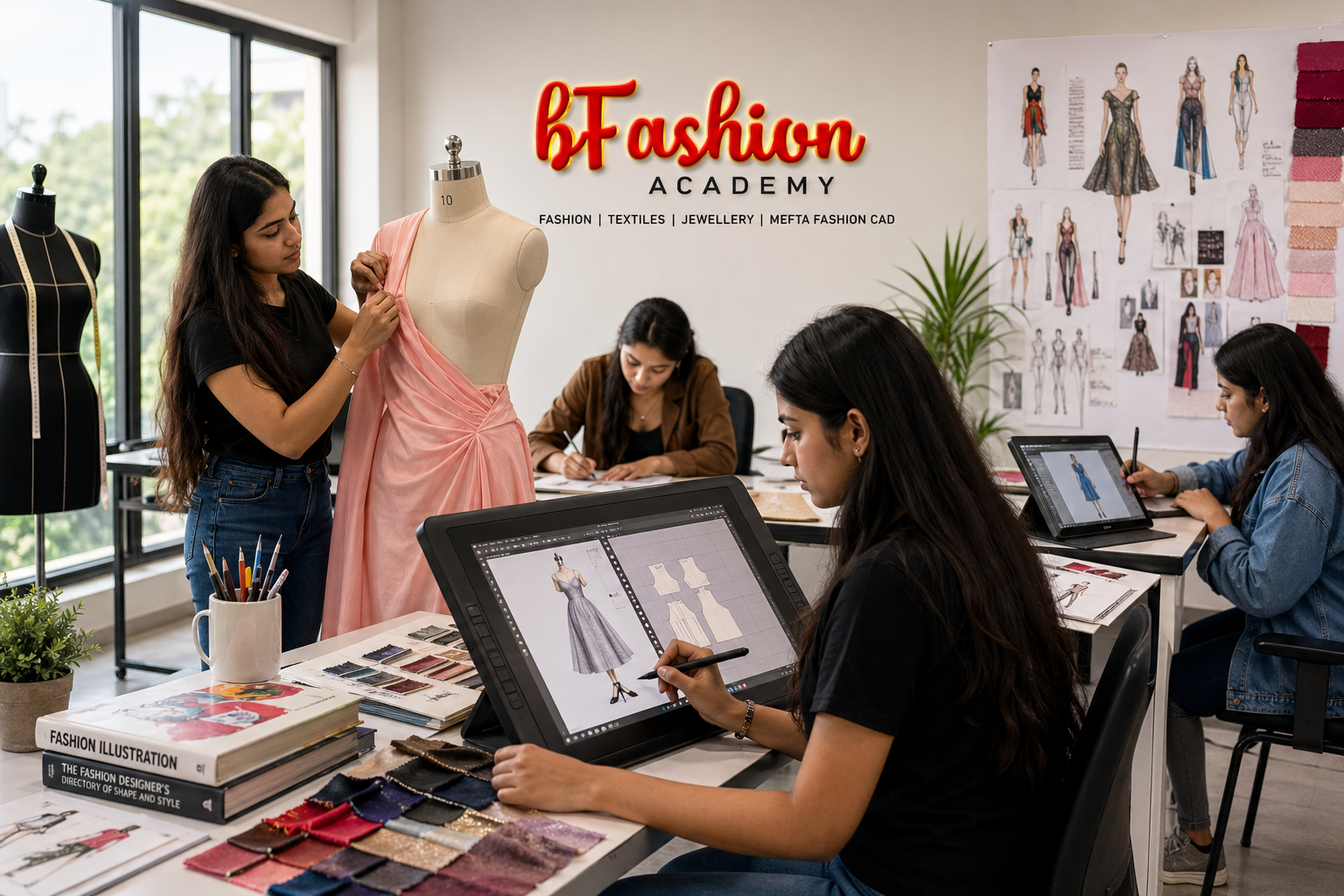
The New Era of Fashion in 2026: With a Fashion Designing Course
The Old Path to Fashion Isn’t Enough Anymore
Meera had just finished her 12th grade when she told her parents she wanted to become a fashion designer. They smiled, nodded, and then asked the same question that families across Chandigarh, Mohali, and Panchkula have been asking for years: “Beta, after spending lakhs on a fashion designing course, will you really get a good job?”
Three years ago, that question didn’t have a very reassuring answer. Many fashion graduates struggled to find meaningful work, often ending up in boutique stitching jobs or sales roles that had little to do with the creative career they had dreamed of. The problem wasn’t their talent or passion. The problem was that the old model of fashion education – sketching, sewing, and theory-heavy textbooks – wasn’t preparing them for an industry that had already begun to change faster than anyone anticipated.
Fast forward to 2026, and the landscape looks dramatically different. But here’s the catch: the opportunities have exploded, but only for those who learn the right skills, in the right way, from the right institute.
The Aspiration: What It Really Means to Be a Designer in the AI Age
If you’re reading this, you probably have a clear picture in your mind – sketching elegant silhouettes, selecting beautiful fabrics, watching your creations come to life on a runway. That vision isn’t wrong. It’s just incomplete.
Today’s fashion designer does all of that and much more. She also opens CLO 3D software to drape a garment on a virtual model before cutting a single meter of fabric. She uses generative AI to explore a hundred colour variations in an afternoon. She understands how blockchain verifies the organic origin of a cotton shirt, and how data analytics predict which colours will sell out next season.
The best part? This shift has made fashion design more accessible, more exciting, and more financially rewarding than ever before – but only for those who embrace it.
What This Guide Will Do For You
This is not another generic article listing fashion design courses. This is a complete roadmap written for students and parents in Chandigarh, Mohali, and Panchkula who want to make an informed decision about fashion education in 2026. We will show you exactly which skills matter, how AI has transformed the industry, what kind of salaries you can expect, and why bfashion academy is the right choice for a future-ready fashion designing course in chandigarh.
Why Fashion Design in 2026 is Completely Different from Five Years Ago
The Fusion of Art and Artificial Intelligence
Let’s start with a number that should catch your attention. The global AI in fashion market was valued at 3.6billionin2026, and it is projected to reach 20.9 billion by 2031, growing at an astonishing compound annual rate of 42.2 percent. This isn’t a distant future scenario. This is happening right now, in design studios, manufacturing units, and retail chains across the world.
According to McKinsey’s 2026 State of Fashion report, 67 percent of fashion executives now say AI is core to their product development process. Virtual try-on adoption grew by an incredible 312 percent year-over-year among mid-market retailers. Generative AI alone is expected to add 150to275 billion in operating profit to the apparel and fashion industry over the next three to five years.
What does this mean for you as a student? It means that the fashion industry is actively looking for designers who understand both a sketchpad and a software dashboard. The days when “tech” was someone else’s job are over. Today, every fashion designer needs to be tech-literate, data-aware, and AI-comfortable.
From Sketches to Screens: The Rise of Digital-First Design
Consider what’s happening inside top design studios. In February 2026, Istituto Marangoni Mumbai delivered an AI training program exclusively for Tata Trent’s design team – the powerhouse behind Westside and Zudio. The training focused on using generative AI platforms like Midjourney to compress what used to take days of mood boarding into minutes of precision visuals. This wasn’t a theoretical workshop. This was hands-on creative training for one of India’s largest retail design teams.
Similarly, in Baghpat, the Chaudhary Ajit Singh Centre of Excellence for Design and Fashion Technology was inaugurated in 2026 with eight AI-enabled programs, including AI in fashion design, 3D prototyping, smart cutting, and CAD-CAM systems. The facility is equipped with 43 advanced sewing machines, including eight AI-enabled machines that can automatically detect fabric type and thickness and adjust stitching parameters accordingly.
These are not isolated experiments. This is the new normal of the fashion industry.
Real Industry Shift: What Industry Experts Are Saying
“STCH is revolutionizing fabric development with AI,” reports The Economic Times. This Indian startup, founded in 2025 by former Zetwerk executives, raised $5.5 million to build what they call a “fabric GPT” – a system trained on large datasets of textile recipes and outcomes to help fashion brands design and source materials efficiently.
Across the industry, emerging designers are embracing AI not as a replacement for creativity but as a tool to do more with less. As one emerging designer told Vogue in their Fall/Winter 2026 coverage, “It can really speed things up at the mock-up stage. You can be like: I like this aspect of this image you’ve generated, and I don’t like this one – and from there, you can save a team member’s time and allow them to spend more on getting the final print done”.
The message is clear. The fashion industry has changed, and fashion education must change with it.
Types of Fashion Designing Courses After 12th
Short-Term Certification vs Diploma vs Degree Programs
When you start looking at fashion designing courses after 12th in Chandigarh, you will encounter three main types of programs. Each serves a different purpose, and the right choice depends on your career goals, time availability, and learning style.
Certificate programs typically last from six months to one year. They focus on specific skills such as CAD for fashion, fashion illustration, or garment construction. These are excellent if you want to quickly gain a specific competency or if you are already working and looking to upskill. Diploma programs usually run for one to two years and offer a more comprehensive curriculum covering design principles, textiles, pattern making, and basic digital tools. They are a good middle ground for students who want solid training without committing to a full degree.
Bachelor’s degree programs – B.Sc. in Fashion Design, B.Des in Fashion Design, or B.Fashion Design – typically span three to four years. These provide the deepest learning experience, covering everything from traditional draping and tailoring to advanced digital design, portfolio development, and industry internships. According to 2026 data, the fees for these programs vary significantly across institutes, from approximately ₹1.45 lakhs for a three-year B.Sc program at autonomous institutes to ₹6.77 lakhs and above for four-year B.Des programs at established institutions.
Specialized Programs Worth Your Attention in 2026
Beyond the general fashion design degrees, several specialized programs have gained prominence in 2026. These include:
Fashion Design with AI and Digital Tools: Programs that specifically integrate generative AI, 3D prototyping, and CAD-CAM training alongside traditional design subjects. These are no longer niche electives – they are becoming core requirements.
Sustainable Fashion Design: With India targeting $100 billion in textile exports by 2030 and the EU tightening sustainability regulations, designers who understand circular economy principles, eco-friendly materials, and waste reduction are in high demand.
Fashion Merchandising and Retail Management: For students interested in the business side of fashion, these programs cover trend analysis, product planning, sales strategy, and digital retail.
Textile Design: This specialization delves deep into fabric creation, weaving, printing, and textile technology – skills that remain fundamental to the fashion industry.
Virtual Fashion and Metaverse Design: Yes, this is real. Students are now learning to design garments for avatars, create digital-only collections for gaming platforms, and produce virtual fashion shows. As Bennett University puts it, “Designing for avatars means questioning the very definition of clothing. A digital gown may have a trail of fire or wings that expand with each step, something no seamstress could stitch”.
Core Skills Every Future Fashion Designer Must Master
H3: Traditional Foundations That Still Matter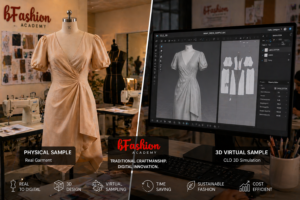
Let’s be clear about something important. Technology has not made traditional fashion skills obsolete. If anything, it has made them more valuable when combined with digital fluency. You still need to understand how fabrics behave, how patterns fit on real human bodies, how draping works, and how colours interact. These are non-negotiable fundamentals.
The difference is that today, you learn these skills alongside their digital counterparts. You still learn pattern drafting, but you also learn how to create and modify digital patterns in CAD software. You still learn garment construction, but you also understand how to simulate fabric drape in 3D.
Digital Skills That Set You Apart
This is where the real differentiation happens. According to data from leading fashion job platforms in 2026, the most in-demand digital skills for fashion designers include:
3D Virtual Sampling Software: CLO 3D and Browzwear have become essential tools. Job postings explicitly require “proficiency in 3D virtual sampling software like CLO 3D, Browzwear, or equivalent”.
Adobe Creative Suite: Adobe Illustrator remains the industry standard for technical design and flat sketches. Photoshop is widely used for presentations and mood boards.
CAD for Fashion: Computer-aided design software for creating precise technical drawings and specifications.
AI-Based Image Generation: Tools like Midjourney and other generative AI platforms are increasingly used for ideation, colour exploration, and rapid visualization.
AI Literacy – The Non-Negotiable Skill for 2026 and Beyond
Here’s what most articles won’t tell you. AI literacy in fashion isn’t about becoming a programmer. It’s about understanding what AI can and cannot do for a designer, and how to use it strategically.
According to fashion industry leaders, the most successful designers in 2026 are those who view AI “as an extremely quick assistant that has no opinions. They feed it references, beat it, discard ninety percent of its run, and retain the ten percent that refines the idea that they were already making”.
AI moodboards have become essential for fashion creatives. A recent Business of Fashion and McKinsey report noted that over 35 percent of fashion leaders are already utilizing generative AI in image creation, copywriting, and product discovery. One fashion brand’s implementation of a generative toolkit reportedly reduced their design team’s early exploration time by 75 to 80 percent.
Does this mean AI is replacing designers? No. As one industry report clarifies, “While AI can generate thousands of designs based on data, it lacks the ‘cultural intuition’ and emotional storytelling that define great fashion houses”. AI is an amplifier, not a replacement. But designers who cannot use it will find themselves competing against those who can.
How AI is Reshaping Every Stage of the Fashion Value Chain
AI fashion design skills
AI in Design Ideation and Mood Boarding
The very first step of fashion design – developing the initial concept and mood board – has been transformed by AI. What used to take days of cutting pictures from magazines, visiting fabric stores, and creating physical reference boards can now be accomplished in minutes.
Designers use AI to generate variations of a silhouette, experiment with colour combinations, and create realistic renders of fabric textures on digital garments. As one designer explained, “When you’re coming up with all kinds of ideas and potential solutions, being able to get it out of your head and into a physical form with AI means that you’re discussing something that’s real, something that you’re all looking at, and it becomes objective rather than subjective”.
AI in Fabric Sourcing and Supply Chain
Behind every beautiful garment is a complex story of fabric sourcing, manufacturing, and logistics. AI is making this story more efficient, transparent, and sustainable.
Take the startup STCH, which raised $5.5 million in 2026 to build an AI-driven fabric R&D platform. The company uses AI to scan global fashion trends, decode fabric compositions through image and data analysis, and recreate similar materials through its manufacturing network. Their goal is to reduce the trial-and-error in fabric creation, allowing brands to get from concept to production faster and with less waste.
AI in Virtual Sampling and 3D Prototyping
Perhaps no area has been transformed more dramatically than sampling. Traditionally, designers would create multiple physical samples of a garment, each requiring fabric, labour, and time. Today, virtual sampling allows designers to create photorealistic 3D prototypes that can be tested for fit, drape, and movement on various body types without cutting a single piece of fabric.
As one industry note pointed out, “Every garment begins as a ‘digital twin,’ a virtual version that can be tested for drape, fit, and movement on various body types before a single piece of fabric is cut”. This eliminates the need for dozens of physical prototypes, saving thousands of gallons of water and reducing textile waste.
AI in Production and Smart Manufacturing
On the factory floor, AI-enabled machines are changing how garments are produced. The Centre of Excellence in Baghpat features AI-enabled sewing machines that can automatically detect fabric type and thickness – cotton, jersey, woven, or twill – and accordingly adjust parameters like foot pressure, stitching speed, and stitches per inch.
This isn’t futuristic speculation. This is happening in India, right now.
AI in Retail, E-commerce, and Consumer Styling
Finally, AI has transformed how fashion reaches consumers. Virtual try-on technology, powered by AI, now allows shoppers to see how clothes look on their own bodies before buying online. AI-powered trend forecasting platforms scan social media and street-style imagery to identify emerging micro-trends in days rather than months. Personal stylist algorithms recommend outfits based on individual preferences, body measurements, and past purchases.
For a fashion designer, understanding this entire ecosystem – from ideation to retail – is what separates a good designer from a great one.
Sustainability as the New Fashion Currency
The Circular Economy: India’s Bold New Direction
There is another trend shaping fashion in 2026 that you cannot afford to ignore: sustainability. But this is not the “use less plastic” sustainability of your school projects. This is serious, industry-wide transformation backed by government policy, corporate investment, and consumer demand.
The Indian government has launched several initiatives to push the textile sector toward sustainability. A pilot project titled “Eliminating Hazardous Chemicals from Textile Fashion Supply Chain in India” is being implemented across 400 factories and four fashion houses, designed to reduce harmful chemical use by 10,530 tonnes. The Tex-Eco Initiative is preparing Indian exporters for the EU’s strict sustainability regulations, which could otherwise lock them out of major markets.
The BioTex Fashion & Circularity Summit 2026 projected that scaling circularity could create 5 to 7 million new jobs in India by 2030 – mostly in agro-waste processing, textile recycling, and digital traceability roles.
Tech Meets Green: AI-Native Sustainable Fashion
Indian climate tech startups are leading the charge. GreenStitch, ZYOD, and Stylumia are using AI fashion design skills to make fashion sustainable – cutting emissions, reducing overproduction, and helping brands transition to circular business models.
For fashion design students, this means that sustainability is no longer a “nice to have” skill. It is a core competency that employers will expect. Understanding life cycle analysis, eco-friendly material sourcing, zero-waste pattern cutting, and digital product passports will make you stand out in the job market.
Chandigarh – An Emerging Powerhouse for Design Education
Why the Tricity is Gaining Traction Among Aspiring Designers
Chandigarh is no longer just an administrative capital or a model city. It is steadily emerging as one of North India’s most significant centers for creative education. The region – including Chandigarh, Mohali, and Panchkula – has seen a sharp rise in demand for skill-based fashion design courses, driven by growing employment prospects in the global fashion and lifestyle industry.
What makes Chandigarh special for fashion education? Several factors come together here. The quality of life is excellent, with a safe, clean environment that
both students and parents appreciate. The cost of living is reasonable compared to fashion education hubs like Delhi or Mumbai. The presence of multiple reputable institutes creates healthy competition and keeps educational standards high. And perhaps most importantly, the industry linkages of institutes in the Tricity are strong, with recruiters from across North India looking here for talent.
Why bfashion academy Stands Out in Chandigarh for the Best Fashion Designing Course
Among the institutes in the Tricity, bfashion academy has emerged as a clear leader in AI-integrated fashion education. Unlike traditional schools that treat digital tools as an afterthought, bfashion academy has built its entire curriculum around the principle that future designers must be fluent in both art and AI.
AI-Integrated Curriculum: At bfashion academy, students learn industry-standard software like CLO 3D, Browzwear, Adobe Illustrator, and generative AI tools from their very first semester. The academy has dedicated labs equipped with AI-enabled sewing machines, 3D prototyping workstations, and CAD-CAM systems – exactly the same equipment used in modern fashion houses.
Industry-Expert Trainers: The faculty at bfashion academy are not academic theorists. They are working professionals with years of experience at brands like FabIndia, Raymond, AND, and Global Desi. They bring real-world briefs, deadlines, and client expectations into the classroom.
Practical, Project-Based Learning: There are no boring lectures here. Students work on live projects from day one – designing for real clients, participating in fashion shows, and building portfolios that showcase both physical garments and digital renders.
Placement Support That Works: bfashion academy maintains strong placement ties with over 60 fashion houses, export houses, and retail brands. The placement team starts working with students from the first semester, conducting workshops on portfolio building, interview preparation, and industry networking. The result is a placement rate consistently above 85 percent, with the lowest package at ₹5 LPA and the highest reaching ₹9 LPA.
Sustainability Focus: Recognizing the growing importance of eco-fashion, bfashion academy has integrated sustainable design thinking into all its programs. Students learn about circular economy principles, zero-waste pattern cutting, and eco-friendly material sourcing – skills that are increasingly demanded by employers.
How to Choose the Right Fashion Designing Course in 2026: Factors That Matter More Than Brochure Claims
With multiple institutes offering similar courses, how do you make the right choice? Here is a practical framework based on what actually leads to successful careers.
First, look at the curriculum. Is it updated for 2026? Does the institute teach CLO 3D, CAD, and AI tools alongside traditional subjects? If the answer is no, cross them off your list. The industry has moved on, and education must move with it. bfashion academy, for example, has an AI-first curriculum that includes generative AI for design, 3D virtual prototyping, and digital fabric sourcing.
Second, evaluate industry exposure. How many live projects, internships, and workshops does the institute offer each year? Which brands do they partner with? The institutes that produce industry-ready graduates are the ones that get students out of the classroom and into real design environments. bfashion academy partners with leading fashion ho
uses and organizes regular studio visits, guest lectures, and real-world assignments.
Third, check placement support. Ask for verifiable placement records. What is the placement rate? Which recruiters come to campus? What are the average and highest packages offered? Be wary of vague claims. bfashion academy provides transparent placement data and has a dedicated placement cell that works year-round.
Fourth, meet the faculty. Are the teachers experienced industry professionals, or are they academic theorists? The best fashion design instructors have worked in the industry, faced real deadlines, satisfied real clients, and can bring that practical wisdom into the classroom. At bfashion academy, all core faculty have a minimum of 8 years of industry experience.
Fifth, visit the campus. See the labs, the equipment, the library. Talk to current students. Ask them honestly about their experiences – what they love and what they wish was better. bfashion academy welcomes prospective students and parents for campus tours and trial classes.
Red Flags and Green Lights in Fashion Designing Course
Watch out for these red flags:
-
Institutes that claim 100 percent placement guarantees – legitimate institutes don’t make such claims because placements depend on student performance and market conditions.
-
Outdated curricula that still treat digital tools as optional extras.
-
Faculty with no industry experience beyond a few internships.
-
Institutes that can’t or won’t share placement data.
Green lights to look for:
-
Transparent placement records with verifiable numbers.
-
Regular industry guest lectures and workshops.
-
Mandatory internships as part of the program.
-
Students who confidently share their portfolios.
-
A curriculum that explicitly includes AI, 3D design, and digital tools – exactly what bfashion academy offers.
Career Opportunities After a Fashion Designing Course in 2026
Traditional Career Paths – Refreshed for the New Era
The career scope in fashion design has expanded significantly. According to 2026 data, it is no longer limited to becoming a designer or working with a fashion label. Today, fashion is connected with business, technology, content, and branding.
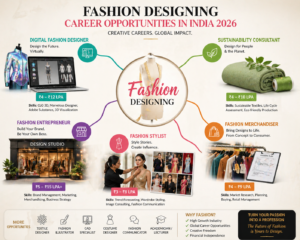
Fashion Designer: Designers work on concepts, collections, and product development. Today, they are also expected to understand production, pricing, and market demand. Average starting salary ranges from ₹3 to ₹6 LPA, with experienced designers earning ₹8 to ₹15 LPA and above.
Fashion Stylist: Stylists are in demand for brand shoots, e-commerce platforms, and influencer content. This is one of the fastest-growing opportunities in fashion design. Average starting salary is ₹2.5 to ₹5 LPA, with freelance projects earning ₹5,000 to ₹50,000 per project.
Fashion Merchandiser: Merchandisers handle product planning, trend analysis, and sales strategy. Average starting salary is ₹4 to ₹7 LPA, rising to ₹10 to ₹18 LPA with experience.
Textile Designer: Textile designers create fabrics and designs for apparel, accessories, and interiors. They use CAD programs and colour theory alongside traditional weaving and printing skills. Salaries range from ₹7 to ₹10 LPA for experienced professionals.
Emerging Roles: Digital Fashion Designer, Sustainability Consultant, Virtual Merchandiser
The most exciting career opportunities in 2026 are the ones that didn’t exist five years ago.
Digital Fashion Designer / 3D Garment Prototyping Specialist: Job postings in 2026 explicitly seek designers with CLO 3D and Browzwear proficiency, offering annual packages of ₹3.6 lakh to ₹6 lakh for entry-level roles, and ₹15 lakh to ₹30 lakh for experienced professionals. Graduates of bfashion academy are uniquely positioned for these roles because of their intensive training in 3D prototyping.
Sustainability Consultant: With the government pushing circular economy initiatives and international markets demanding eco-compliance, sustainability consultants who understand fashion’s environmental impact are highly valued.
Virtual Fashion Designer: Designing digital-only clothing for avatars, gaming platforms, and virtual fashion shows. As one publication noted, “Students can now aspire to roles that didn’t exist a decade ago: digital garment developer, AR fashion stylist, avatar wardrobe curator, and metaverse brand consultant”.
AI-Assisted Designer: Professionals who combine creative design with generative AI fashion design skills to accelerate concept development and visualization.
Entrepreneurship: Launching Your Own Label
Many students now launch independent labels, Instagram-based brands, or niche fashion businesses instead of working for someone else. Income varies, but successful brands scale quickly with the right positioning. The proliferation of e-commerce platforms, print-on-demand services, and social media marketing has lowered the barriers to entry. bfashion academy actively encourages entrepreneurial thinking and offers modules on fashion business management.
Freelance Fashion Designing: A Realistic Option in 2026
Freelancing has become a legitimate career path in fashion design. According to 2026 data, the average earnings of an Indian freelance designer range between ₹3 lakh and ₹8 lakh annually. Beginners earn ₹15,000 to ₹30,000 per month, while experienced freelancers can earn ₹60,000 to ₹1.5 lakh per month.
Common freelance gigs include custom sketches, bridal wear design, brand identity for fashion labels, and collection development for smaller brands. Platforms like Upwork, Fiverr, and Instagram have made it easier than ever to find clients.
Fashion Designer Salary Insights 2026 (India & Chandigarh)
Entry-Level to Senior-Level Salary Progression
Based on comprehensive 2026 salary data, here is what you can expect at different career stages:
Entry-level (0 to 2 years experience): ₹15,000 to ₹30,000 per month. Common roles include interns for fashion boutiques, assistant designers, and trainees for garment houses.
Mid-level (3 to 5 years experience): ₹35,000 to ₹70,000 per month. Roles include fashion illustrator, fashion coordinator, fashion product developer, and export house designer.
Senior-level (5 to 10 years experience): ₹80,000 to ₹1.5 lakh per month. Roles include lead designer, creative designer, fashion brand owner, and celebrity designer.
At the very top, high achievers in premier institutions can earn ₹35 to ₹50 LPA.
Role-Based Salary Breakdown
Here is how different fashion roles compare in 2026:
-
Fashion Designer (Apparel): ₹3 to ₹6 LPA (starting), ₹8 to ₹15 LPA (experienced)
-
Fashion Stylist: ₹2.5 to ₹5 LPA (starting)
-
Fashion Merchandiser: ₹4 to ₹7 LPA (starting), ₹10 to ₹18 LPA (experienced)
-
Textile Designer: ₹7 to ₹10 LPA (experienced)
-
Fashion Entrepreneur: Highly variable; successful brands can generate ₹20 to ₹50 LPA or more
Freelance vs Salaried: What Pays Better
Freelancing often pays more per project, but income is less predictable. Salaried roles offer stability and benefits but may have a lower ceiling early in your career. Many successful fashion professionals combine both – working a salaried role while taking freelance projects on the side.
Real Student Journeys – From Classroom to Runway
Learning in a Live Studio Environment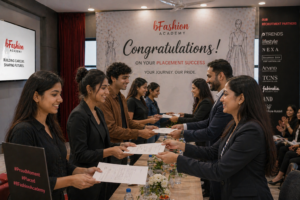
Theory alone will never make you a great designer. At bfashion academy, we believe that the best way to learn is by doing. Our classrooms function like design studios, with students working on real projects that simulate industry conditions.
Our faculty members are not academic theorists – they are industry professionals who have worked with brands, faced deadlines, and know what it takes to succeed. With over 45 industry mentors involved in teaching, our students get direct access to professionals who are actively shaping the fashion industry.
Building a Portfolio That Opens Doors
One of our students, Priya (name changed for privacy), came to us after 12th with excellent sketching skills but no idea how to translate them into a professional portfolio. Over two years at bfashion academy, she learned pattern drafting, CAD for fashion, CLO 3D for virtual sampling, and digital presentation skills. By her final semester, she had a portfolio with three complete collections – both physical pieces and digital renders. She was placed with a leading fashion brand in Delhi with a starting package of ₹5 LPA.
Another student, Rahul, was more interested in the technical side of fashion. He specialized in garment technology and CAD pattern making. After completing a six-month internship with a garment export house in Mohali – arranged through bfashion academy’s placement cell – he received a pre-placement offer and now manages production for a major apparel brand.
These are not exceptional cases. They are the norm at bfashion academy because we design our programs for outcomes, not just for academic completion.
The Placement Experience: How It Really Works
Our placement team begins working with students from their first semester, not in their final year. We conduct regular workshops on portfolio building, interview preparation, and presentation skills. We invite recruiters for guest lectures and portfolio reviews throughout the year.
At the time of placement, we coordinate with over 60 prominent design houses and retail brands that recruit from our campus annually. Our placement rate consistently exceeds 85 percent, with the lowest package offered at ₹5 LPA and the highest reaching ₹9 LPA.
Future Scope – Where is the Fashion Industry Headed by 2030?
Five Predictions You Need to Prepare For
Prediction 1: AI will be embedded in every design tool. Already, tools like CLO 3D and Browzwear are integrating AI capabilities. By 2030, AI fashion design skills will be a standard feature, not a special skill. At bfashion academy, we ensure our students are already fluent in these tools.
Prediction 2: Sustainability will be mandatory, not optional. With the EU implementing digital product passports and India pushing circular economy initiatives, designers who cannot work with sustainable materials and processes will be unemployable.
Prediction 3: Virtual fashion will become mainstream. Digital-only clothing for avatars and virtual fashion shows will generate billions in revenue. Designers who understand this space will have unique opportunities.
Prediction 4: Fashion and tech will fully merge. The line between fashion designer and technologist will blur. Understanding data, automation, and digital prototyping will be as fundamental as understanding fabric.
Prediction 5: India will become a global fashion sourcing and design hub. With initiatives like PM MITRA parks and rising global demand for sustainable textiles, India’s fashion industry is poised for massive growth. Fashion designers trained at bfashion academy will have opportunities that extend far beyond national borders.
The Decade Ahead: Jobs That Don’t Exist Yet
Just as “digital fashion designer” didn’t exist in 2020, new roles will emerge that we cannot fully anticipate today. The best preparation is not learning a specific tool – it is learning how to learn, how to adapt, and how to combine creative thinking with technical competence.
This is exactly what bfashion academy’s approach provides. We don’t just teach you today’s tools. We teach you how to stay updated, how to evaluate new technologies, and how to apply your core design knowledge in whatever medium the industry demands.
Conclusion – Your Next Step Toward a Future-Ready Fashion Career
Don’t Just Follow Trends – Lead Them
The fashion industry in 2026 is full of opportunity for those who are prepared. The global AI fashion design skills in fashion market is growing at 42 percent annually. Sustainability is creating millions of new jobs. Digital fashion is opening entirely new career paths. And Chandigarh, with excellent institutes like bfashion academy, is an ideal place to begin.
But opportunity only benefits those who are ready to seize it. Ready means choosing the right course, the right institute, and the right skills.
Take Action Today, the best fashion design institute in Chandigarh
If you are a student finishing 12th or a parent helping your child make this decision, here is what you should do right now:
First, visit the bfashion academy campus. See our AI-enabled labs, meet our industry-expert faculty, talk to our current students. Get a feel for what a practical, future-focused fashion education looks like.
Second, ask for our placement records. We are transparent about our outcomes because we are proud of them. See for yourself where our graduates are working.
Third, enroll for a free career counseling session. We will help you understand which program fits your goals, budget, and schedule.
The fashion industry has changed. Fashion education must change with it. At bfashion academy, we have already made that change. Now it’s your turn to take the next step.
Call us today for a free career counseling session at the best fashion design institute in chandigarh for fashion designing course after 12th.
Frequently Asked Questions: Best Fashion Design Institute in Chandigarh
1. Which is best fashion designing course after 12th in Chandigarh?
The best fashion design institute in Chandigarh, the course you take depends on your career goals. If you want a comprehensive education covering both traditional and digital design, a three-year B.Sc. in Fashion Design or B.Des program is ideal. If you want to quickly gain specific skills, diploma or certificate programs focused on CAD, AI tools, or garment construction are excellent options. bfashion academy offers both degree and diploma programs with an AI-integrated curriculum which is best fashion designing course after 12th
2. How long is a fashion designing course after 12th?
Fashion Designing Course duration varies. Certificate programs can be completed in 6 to 12 months. Diploma programs typically take 1 to 2 years. Undergraduate degree programs (B.Sc. or B.Des) usually take 3 to 4 years. At bfashion academy, we offer flexible options so you can choose based on your time availability and career goals.
3. Is fashion designing course a good career choice in 2026?
Yes, but only if you learn the right skills. The industry has transformed dramatically. Designers who understand digital tools, AI, and sustainability have excellent opportunities. Those who only learn traditional skills may struggle. The career scope has expanded into digital fashion, virtual design, sustainability consulting, and fashion tech roles that didn’t exist a few years ago.
4. What is the average salary of a fashion designer in Chandigarh?
Entry-level fashion designers in Chandigarh typically earn between ₹15,000 and ₹30,000 per month. Experienced designers with 3-5 years of experience can earn ₹35,000 to ₹70,000 per month. Senior designers and those working with established brands can earn ₹80,000 to ₹1.5 lakh per month or more. Freelance designers’ earnings vary but can be equally lucrative. Graduates of bfashion academy often secure packages at the higher end of these ranges.
5. Do I need to know drawing to pursue fashion designing?
Drawing skills are helpful but not mandatory. Many successful fashion designers come from non-art backgrounds. What matters more is spatial awareness, understanding of proportions, and the ability to communicate your ideas visually. Digital tools like CAD and Adobe Illustrator can compensate for limited traditional drawing skills. bfashion academy offers foundation modules to help all students develop their visual communication abilities.
6. What is the difference between B.Sc. Fashion Design and B.Des Fashion Design?
Both are undergraduate fashion design degrees, but they differ slightly in focus. B.Des (Bachelor of Design) is typically more conceptual, creative, and design-focused, often with more emphasis on portfolio development. B.Sc. Fashion Design is somewhat more structured and technical, with more focus on garment construction, textiles, and production processes. Both are valuable, and the best choice depends on your strengths and career goals. bfashion academy offers both pathways.
7. Which fashion designing college is best in Chandigarh for AI-focused learning?
bfashion academy is widely recognized as the best choice for students who want an AI-integrated, future-ready fashion education. With industry-experienced faculty, AI-enabled labs, a curriculum that includes CLO 3D and generative AI tools, and a placement rate exceeding 85%, bfashion academy prepares students for the careers of tomorrow.
8. Can I do fashion designing after 12th commerce or science?
Absolutely. Fashion design is open to students from all streams – science, commerce, and arts. The required eligibility for most programs is simply passing 12th from a recognized board. What matters more is your creativity, dedication, and willingness to learn new skills. bfashion academy welcomes students from all backgrounds.
9. What is the fee for the fashion designing course at bfashion academy?
Fees vary by program type and duration. Diploma programs range from ₹80,000 to ₹1.5 lakhs total. Degree programs (3-year B.Sc. or 4-year B.Des) range from ₹1.8 lakhs to ₹4.5 lakhs total, with installment options available. bfashion academy also offers merit-based scholarships and early-bird discounts. Contact the admissions office for the exact fee structure for 2026.
10. Does fashion designing have a future in India?
Very much so. India’s fashion industry is growing rapidly, driven by e-commerce, rising disposable incomes, and increasing global demand for Indian textiles. The government has made the textile sector a priority, with initiatives like the PM MITRA parks and the Tex-Eco Initiative. Sustainability and digital transformation are creating entirely new job categories. Graduates from bfashion academy are well-positioned to capitalize on these trends.
11. What skills are most in demand for fashion designers in 2026?
The most sought-after skills in 2026 include proficiency in 3D virtual sampling software (CLO 3D, Browzwear), Adobe Creative Suite (especially Illustrator), Generative AI tools for ideation, understanding of sustainable materials and circular design, and traditional skills like pattern drafting and garment construction. Employers want designers who can bridge the physical and digital worlds. bfashion academy’s curriculum covers all of these.
12. Can I start my own fashion label after a fashion design course?
Yes, many graduates do exactly that. The course teaches you design, but successful entrepreneurship also requires business skills – understanding pricing, production, marketing, and customer acquisition. bfashion academy offers modules on fashion entrepreneurship and helps students develop business plans for their labels.
13. How do I build a fashion design portfolio during my course?
You start from day one. Save your best sketches, digital designs, and physical garment photos. Document your process – research, mood boards, fabric selection, pattern iterations, final outcomes. At bfashion academy, the curriculum includes dedicated portfolio development sessions where faculty guide you in curating and presenting your best work professionally.
14. Is an internship mandatory in fashion design courses?
Most reputable institutes make internships mandatory because they are essential for industry exposure. Internships give you real experience, help you build professional networks, and often lead to job offers. At bfashion academy, we help students secure internships with fashion brands, export houses, and design studios as part of the program.
15. What is the difference between fashion design and textile design?
Fashion design focuses on creating garments and accessories – the final wearable products. Textile design focuses on creating fabrics and surface patterns – the materials from which garments are made. The two fields are closely related, and many designers work in both areas. bfashion academy offers exposure to both disciplines, allowing students to explore and then specialize.
16. Do fashion designers get government jobs in India?
Yes, opportunities exist in government organizations like the National Institute of Fashion Technology (NIFT), Weavers Service Centres, Handloom and Handicrafts development corporations, and the Textile Ministry. Some students also work with state government initiatives promoting local crafts and textiles. bfashion academy’s placement cell also guides students on government exam preparation when relevant.
17. What is the placement record of bfashion academy?
bfashion academy maintains a placement rate consistently exceeding 85 percent. The lowest package offered is ₹5 LPA and the highest reaches ₹9 LPA. Recruiters include leading fashion brands, export houses, and retail chains. The placement team works with students from the first semester to ensure they are industry-ready.
18. How has AI fashion design skills changed fashion design education?
AI has transformed fashion design education by introducing digital tools into every stage of the design process. Students now learn to use generative AI fashion design skills for ideation, 3D prototyping for virtual sampling, and data analytics for trend forecasting. bfashion academy was an early adopter of AI-integrated curricula, ensuring its graduates are immediately valuable to employers.
19. Is online fashion designing course valid or better than classroom learning at bfashion academy?
Online courses can teach you theoretical knowledge and software skills, but fashion design is fundamentally a hands-on discipline. You need physical exposure to fabrics, practice in fitting garments on real bodies, and collaborative experience in studio environments. bfashion academy offers a blended model – online for theory and software foundations, and mandatory in-person studio sessions for hands-on practice.


